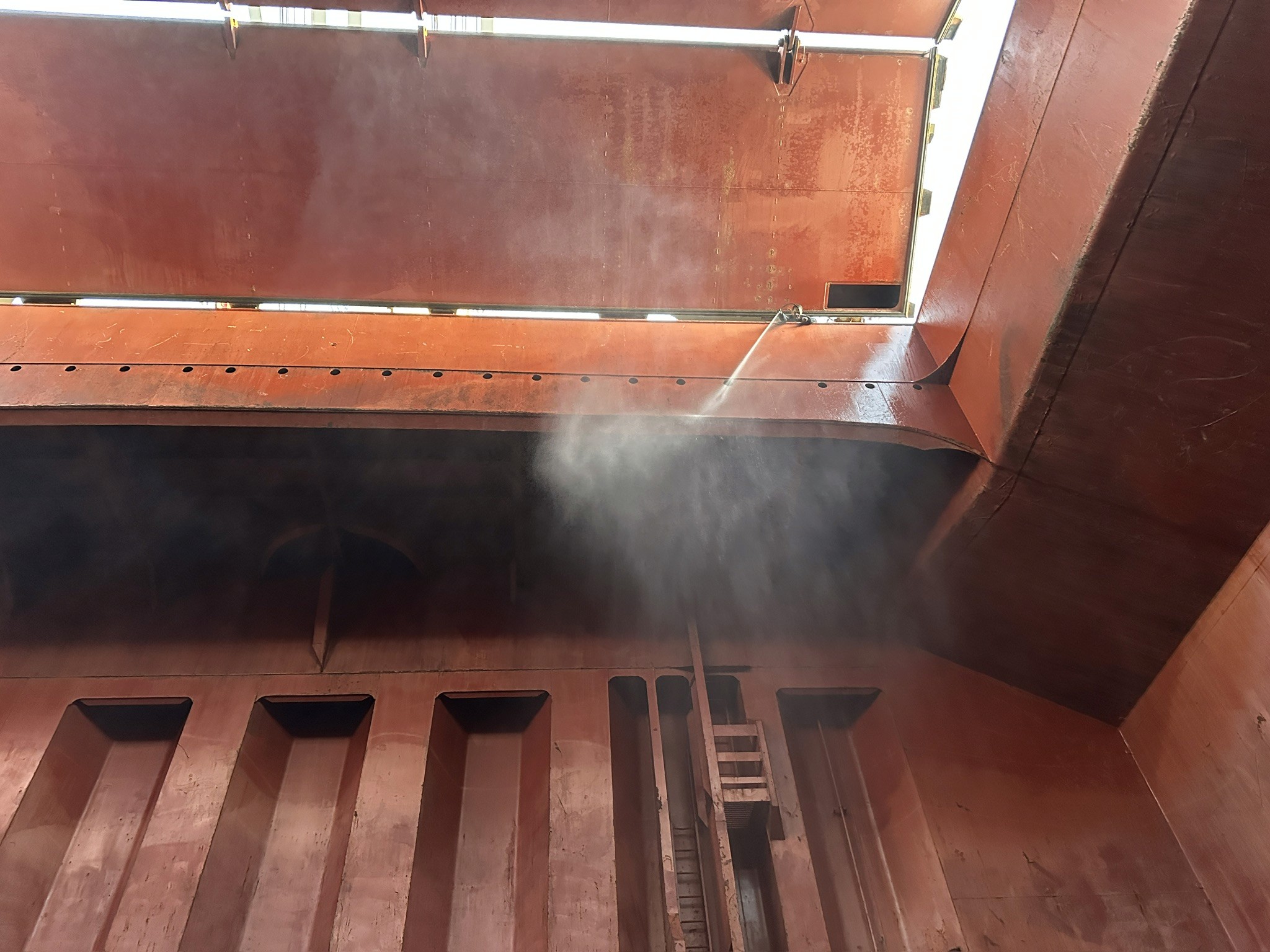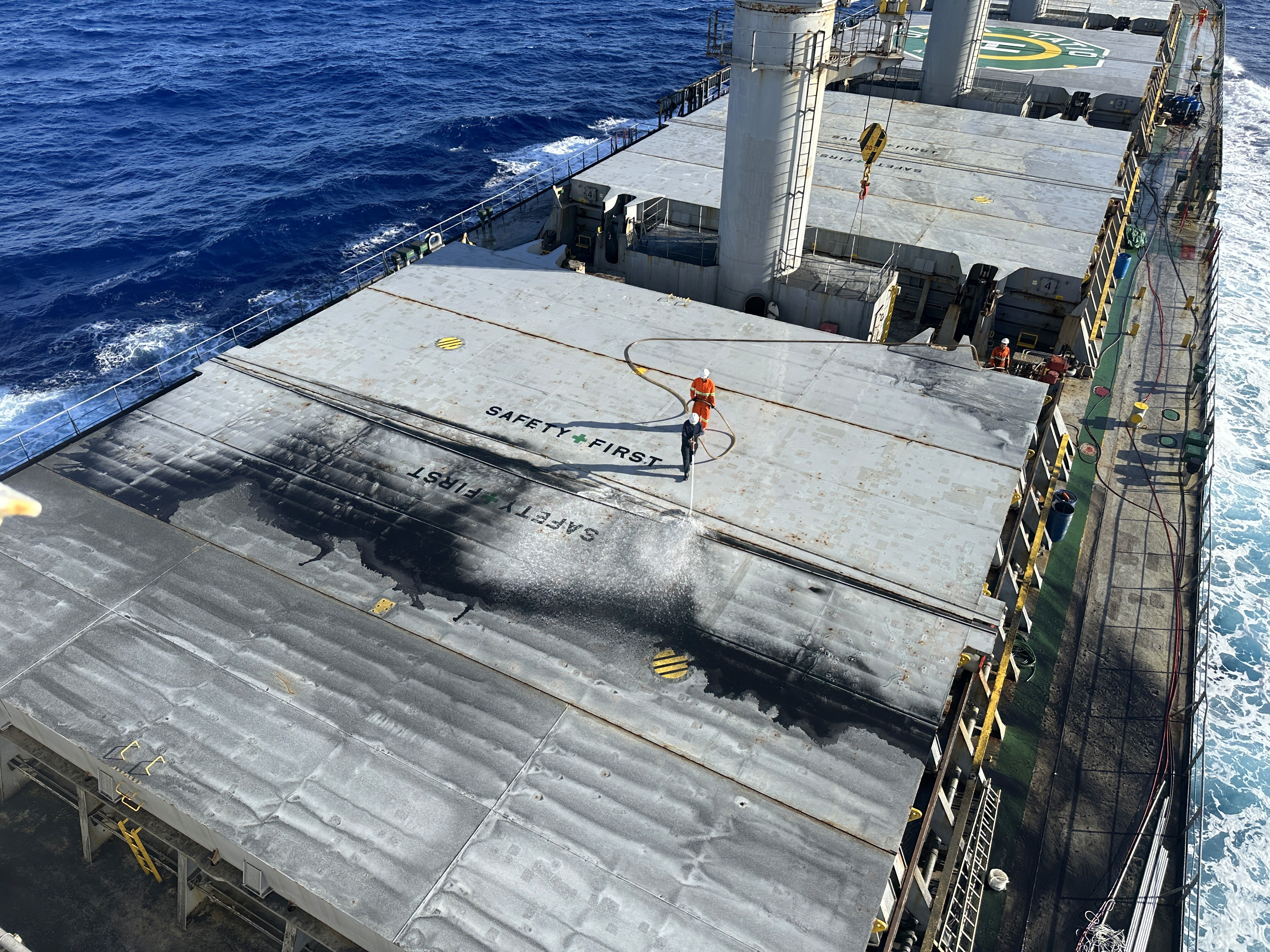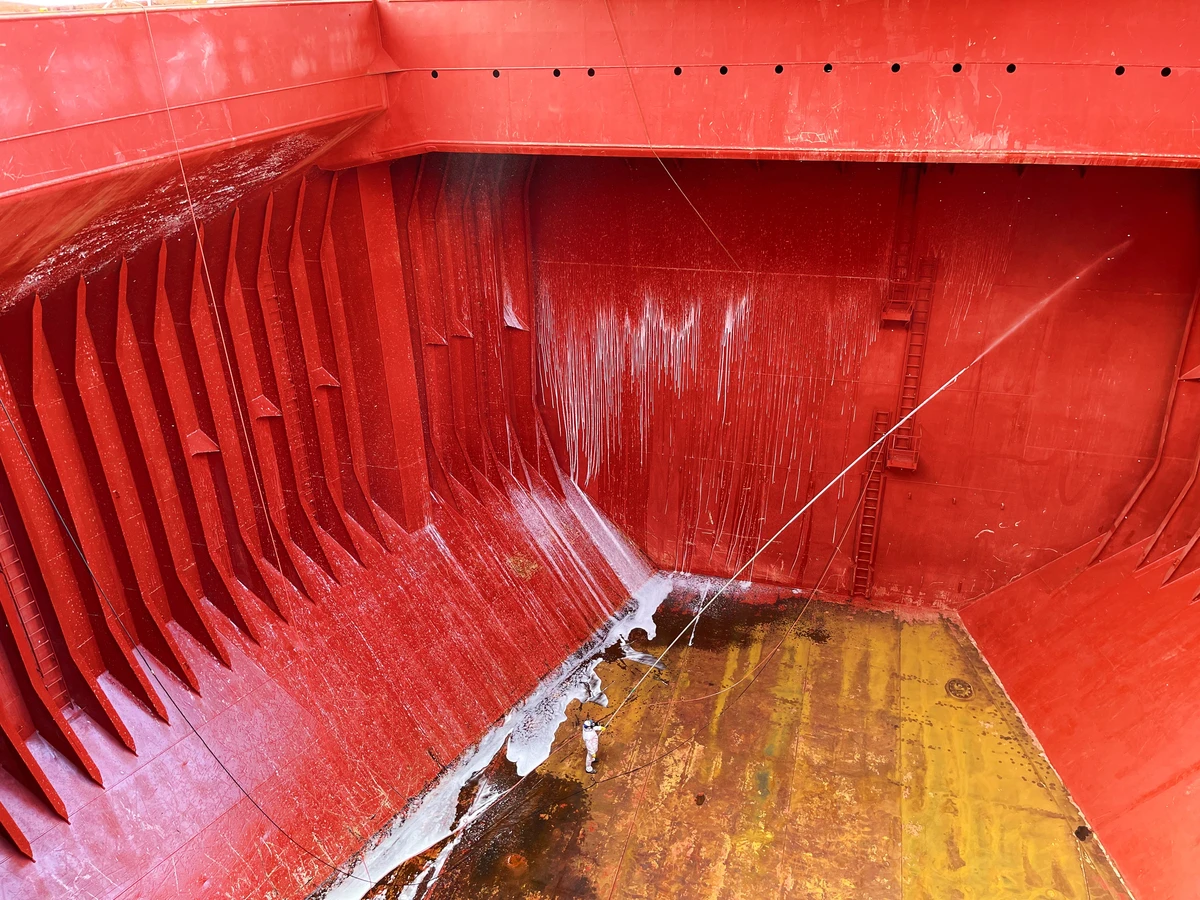
A cargo hold cleaning quotation can look competitive until the vessel reaches port and the parties discover that launch transfers, residue disposal, chemical treatment, surveyor attendance or additional cleaning were never included.
For shipowners, charterers and vessel operators arranging cargo hold cleaning in Brazil, the most important procurement decision is not simply which contractor offers the lowest lump sum. It is whether the quotation defines the required result, the resources needed to achieve it, the acceptance criteria and the responsibilities of every party involved.
This guide explains how to prepare a complete cargo hold cleaning RFQ (Request for Quotation), compare proposals on a like-for-like basis, identify exclusions and coordinate the inspection and acceptance process.
It also includes a ready-to-use RFQ template based on practical considerations for bulk carriers calling Brazilian ports and anchorages.
For service capabilities, operational coverage and direct enquiries, visit Seachios® Cargo Hold Cleaning Services in Brazil.
Quick Answer: What Should a Cargo Hold Cleaning RFQ Include?
A complete cargo hold cleaning RFQ should identify the vessel, port, berth or anchorage, ETA/ETD, number of holds, previous and next cargoes, current hold condition, required cleanliness standard, available working window, utilities, environmental arrangements, surveyor requirements and the commercial terms for scope changes and acceptance.
The essential principle: define what must be delivered, not merely what work must be performed.
A quotation for washing five cargo holds is not necessarily equivalent to a quotation for presenting those holds in a condition acceptable for a nominated grain cargo.
1. Why an Incomplete Cargo Hold Cleaning Quotation Creates Commercial Risk
A cargo hold cleaning operation sits between two commercial commitments: completion of the previous cargo operation and readiness to receive the next cargo.
That makes scope accuracy important.
Consider a vessel expected to load soybeans after discharging a dusty or staining bulk cargo. One contractor quotes high-pressure washing, while another includes preliminary residue removal, targeted chemical treatment, manual finishing, final rinsing and operational documentation.
Both proposals may be described as "cargo hold cleaning", but they do not necessarily deliver comparable services.
Potential consequences of an incomplete RFQ include:
Disagreement over the cleanliness condition required before loading.
Additional charges for work that was not included in the original scope.
Delays caused by unresolved access, water, power or launch arrangements.
Unexpected requirements for residue and wash-water handling.
Rework following inspection findings.
Unclear responsibility for surveyor attendance and reinspection.
Disputes over the application of No Cure, No Pay or other acceptance-related terms.
A well-prepared RFQ cannot eliminate every operational risk. It can, however, reduce preventable ambiguity before mobilization.
2. The 12 Essential Details to Send Before Requesting a Quotation
A professional contractor should receive sufficient information to evaluate the vessel's actual working conditions rather than pricing solely from vessel size or number of holds.
Vessel and schedule
1. Vessel identification: Vessel name, IMO number, vessel type and the principal dimensions when relevant.
2. Location: Brazilian port, terminal, berth or anchorage. Confirm whether the vessel will remain alongside or needs to shift for the service.
3. Schedule: ETA, ETD, discharge completion estimate, earliest safe boarding time and target date for presentation of the holds.
4. Available working window: The realistic period available for mobilization, execution, drying, inspection and potential corrective work.
Cargo and hold condition
5. Number of holds: Identify the exact holds requiring attendance and whether they have different conditions.
6. Previous cargo: Specify the last cargo and disclose relevant previous cargo history where contamination or residues may affect the next loading.
7. Next intended cargo: Identify the commodity, cargo receiver, charterer or shipper requirements and any specific cleanliness condition in the fixture.
8. Existing condition: Provide recent photographs of tank tops, bulkheads, frames, ladders, underdeck structures and other problem areas. Identify accumulated residues, visible corrosion, coating damage and known defects.
Execution and acceptance
9. Available utilities: State whether the ship can supply suitable freshwater, power, lighting, connections and other agreed resources.
10. Port arrangements: Identify the local shipping agent, embarkation requirements, launch availability, terminal restrictions and necessary permissions.
11. Waste handling: Clarify who is responsible for collecting, retaining, transporting and disposing of residues and wash water, as applicable.
12. Inspection requirements: Identify the nominated surveyor or inspecting party, the expected acceptance criteria and the documentation requested at completion.
Where essential information is unavailable, that uncertainty should be disclosed before the contractor issues a binding price.
3. Define the Scope of Work Before Comparing Lump-Sum Prices
A commercial proposal should describe the services included, the services excluded and the circumstances under which additional work requires authorization.
The following matrix is a useful procurement tool. It is not an automatic statement that every Seachios quotation includes every item.
Work item | What the RFQ should establish |
|---|---|
Sweeping and mucking out | Whether remaining loose cargo is removed before washing |
High-pressure washing | Areas covered, proposed equipment and operational limitations |
Chemical treatment | Products, purpose, compatibility and required approvals |
Manual finishing | Frames, ladders, corners and areas inaccessible to main equipment |
Freshwater rinsing | Availability, responsibility and expected final condition |
Drying and ventilation | Required condition and allocation of vessel support |
Bilge wells and drainage | Whether cleaning, pumping or removal is included |
Hatch covers and coamings | Whether internal or external surfaces form part of the scope |
Rust, scale and coating defects | Cleaning limits versus separate surface treatment or repair |
Waste and wash water | Containment, transfer, disposal and documentation responsibilities |
Inspection attendance | Surveyor nomination, cost and reinspection arrangements |
Launch and access | Number of transfers, terminal formalities and associated charges |
Completion documentation | Photographs, activity report and applicable certificates |
A quotation described as all-inclusive or lump sum should still identify its operational assumptions.
All-inclusive does not mean unlimited scope. The agreed inclusions, exclusions and variation procedure remain essential.
Understand the difference between cleaning and repair
Cleaning removes cargo residues and other material within the agreed method and scope. Structural repairs, extensive corrosion treatment, coating reinstatement, steel renewal, hatch-cover repairs and similar interventions are separate activities unless expressly included.
A contractor should not promise that washing alone will correct coating failure or structural deterioration.
For a detailed explanation of cleaning methods and cargo-related preparation, refer to the existing Seachios article: How to Achieve Hold Readiness.
4. Previous Cargo and Next Cargo: How to Describe the Required Result
The incoming cargo, previous residues and actual hold condition together determine what needs to be assessed.
Different cargo transitions create different questions for a contractor.
Previous cargo or condition | Procurement concern | Information to request |
|---|---|---|
Coal or mineral dust | Persistent deposits in structural recesses | Extent of manual finishing and inspection coverage |
Petcoke or oily residues | Adherent films and potential contamination | Whether suitable degreasing and rinsing are included |
Clinker or cement | Hardened deposits or difficult deposits | Proposed removal method and coating protection |
Fertilizer or salts | Residues, moisture and corrosion concerns | Chemical compatibility and surface-condition assessment |
Grain or agricultural cargo | Organic residues and possible infestation | Residue removal and next-cargo acceptance criteria |
Coating deterioration | Loose paint, scale or damaged surfaces | Separate treatment requirements and exclusions |
These are procurement considerations, not a universal cleaning prescription. The chosen method should depend on the actual cargo characteristics, coating condition, safety assessment, applicable requirements and the agreed specification.
For example, requesting grain-clean holds without identifying the intended commodity, the charterparty wording or the inspecting party's criteria may leave the outcome insufficiently defined.
Likewise, terms such as grain clean, hospital clean and water washed must be interpreted in their applicable commercial and technical context. A higher-sounding standard is not automatically required for every cargo.
For cargo preparation and grain-loading considerations, see Cargo Hold Cleaning Brazil: Grain-Ready Bulk Carrier Holds.
5. How to Compare Cargo Hold Cleaning Quotations Fairly
The most useful comparison is not simply Quotation A versus Quotation B. It is the total contractual and operational exposure associated with each offer.
A competitive evaluation should consider five dimensions.
A. Defined service outcome
Does the proposal specify the exact holds and cleanliness condition it is intended to achieve?
B. Included resources
Are manpower, supervision, equipment, chemical materials, mobilization, launch transportation and other support services clearly allocated?
C. Operational assumptions
Does the price assume unrestricted access, sufficient shipboard utilities, suitable weather, available lighting or uninterrupted working hours?
D. Inspection and corrective work
Who arranges the surveyor? What happens if an inspector identifies remaining contamination? What rework is covered, and what happens if an issue lies outside the cleaning scope?
E. Commercial exposure
Are waiting time, repeat launch movements, emergency mobilization, extended attendance and scope variations addressed?
A lower initial price may represent good value when the offers are truly equivalent. It may also reflect services and risks retained by the vessel.
A practical quote-comparison worksheet
Ask each bidder to answer the same questions:
Commercial question | Contractor A | Contractor B |
|---|---|---|
Exact holds and surfaces covered? | Confirm | Confirm |
Required acceptance standard defined? | Confirm | Confirm |
Chemical treatment included where needed? | Confirm | Confirm |
Mobilization and launch transfers included? | Confirm | Confirm |
Residue and wash-water responsibilities defined? | Confirm | Confirm |
Surveyor attendance and cost allocated? | Confirm | Confirm |
Rework obligations and exclusions written? | Confirm | Confirm |
Completion documents specified? | Confirm | Confirm |
Waiting and interruption terms specified? | Confirm | Confirm |
Total agreed commercial price and validity? | Confirm | Confirm |
The objective is not to force every contractor into an identical method. It is to compare the promised outcome, boundaries and total commercial responsibility.
6. What Should "No Cure, No Pay" Actually Mean?
No Cure, No Pay is a commercial commitment that must be defined in the contract, not merely displayed as a slogan.
In cargo hold cleaning, its practical meaning depends on the agreed result, scope, inspection standard, acceptance mechanism and exceptions.
Before accepting a proposal under this model, clarify:
The cure: What exact hold condition constitutes successful completion?
The decision-maker: Who determines acceptance — the Master, Chief Officer, charterer's surveyor or another designated inspecting party?
The inspection basis: Which cargo, surfaces, accessibility conditions and acceptance criteria apply?
Corrective work: Is re-cleaning of areas within the agreed scope included, and how is it arranged?
Exceptions: How are structural defects, coating deterioration, inaccessible areas, new contamination and events outside the contractor's control treated?
Payment trigger: Which inspection record, completion certificate or agreed event establishes payment entitlement?
These details matter because a cleaning contractor performs the service, while acceptance for the intended cargo may depend on a separate inspecting party and requirements outside the contractor's authority.
Completion of cleaning and approval for loading are related, but they are not the same decision.
Any No Cure, No Pay commitment offered by Seachios should be recorded in the applicable quotation and mutually agreed terms, with the service scope and acceptance criteria expressly defined.
7. Surveyor Acceptance: Establish the Evidence Before Work Begins
A surveyor should not first discover the intended cleanliness standard after the contractor has finished.
Where third-party inspection is required, a practical sequence is:
Before mobilization
Obtain the applicable cargo and charterer requirements.
Confirm which party nominates and pays the inspector.
Agree the expected inspection time and areas of attendance.
Share known structural and operational restrictions.
During execution
Maintain a record of the holds and areas attended.
Record relevant restrictions, interruptions and instructed changes.
Take representative before-and-after photographs.
Coordinate the anticipated completion time with the vessel.
At completion
Arrange the Master's or Chief Officer's review.
Present the holds for the agreed inspection.
Record observations and any areas requiring additional work.
Obtain the inspecting party's written findings when available.
Separate the contractor's completion report from any third-party acceptance certificate.
The resulting evidence should identify what was performed, what was inspected, which criteria were used and what was actually accepted.
A cleaning report does not replace class certification, a statutory survey or an independent hold cleanliness inspection.
8. Brazil-Specific Mobilization: Alongside and Anchorage Are Different Jobs
For bulk carriers calling Brazil, location affects both costs and feasibility.
A vessel at a terminal berth may have a different access procedure from one at anchorage. Even within the same port, local permissions, launch arrangements, available working hours and the terminal's environmental requirements can materially change the execution plan.
Ports and maritime regions commonly relevant to cargo hold cleaning enquiries include Santos, Paranaguá, Itaqui/São Luís, Vila do Conde/Barcarena, the Belém area, Vitória and other bulk-cargo locations.
Availability must be confirmed for the specific vessel, date and working position. A company's presence in a region should not be interpreted as blanket authorization to perform every cleaning method at every berth or anchorage.
The mobilization questions that should be settled in advance
Can the shore gang board while the vessel is alongside?
If the vessel is at anchorage, who arranges and pays for launch transfers?
Are additional launch movements included?
Which agent coordinates security access and local clearances?
Are suitable water, power and lighting available?
Is cleaning authorized at the proposed location?
What happens if the vessel shifts berth or anchorage?
What work stoppages may arise from weather, unsafe access or terminal restrictions?
How will the working window accommodate drying and inspection?
This is why the RFQ should always contain the specific port, terminal or anchorage, rather than naming only the country.
9. Environmental and Safety Requirements Belong in the Quotation
Technical procurement is incomplete if residue handling and personnel safety are left undefined.
MARPOL Annex V and cargo residues
Under MARPOL Annex V, cargo residues and hold-washing water must be assessed against the applicable discharge requirements. Residues classified as harmful to the marine environment (HME) are subject to important restrictions, while other categories may have conditional provisions depending on the circumstances.
The required arrangements depend on factors including cargo classification, cleaning agents, location, voyage circumstances and relevant local rules.
A quotation should therefore identify who is responsible for the required collection, retention, transfer, disposal and records.
The fact that a chemical is marketed as biodegradable does not, by itself, establish that every disposal method is permitted.
For primary guidance, consult the International Maritime Organization's MARPOL Annex V information.
Enclosed-space entry and safe working conditions
The work plan must also address safe access, atmosphere assessment where applicable, ventilation, lighting, communications, rescue readiness, trained personnel and the vessel's safety management procedures.
The IMO's revised recommendations under Resolution MSC.581(110) reinforce the importance of identifying enclosed-space hazards, assessing risks and applying appropriate entry procedures.
A contractor should have the authority and operational discipline to stop work when conditions are unsafe, rather than compromise personnel safety to meet an unrealistic schedule.
See DNV's guidance on revised IMO enclosed-space entry recommendations.
Charterparty responsibilities
The allocation of costs and responsibilities may also be influenced by the charterparty.
BIMCO's Hold Cleaning/Residue Disposal Clause for Time Charter Parties is a useful industry reference for understanding why cleaning, cleaning agents, residues, disposal and time allocation should be addressed expressly.
The actual signed contract and its applicable terms remain decisive.
10. Evidence From Brazil: M/V UNIGLOBE at Paranaguá Anchorage
Procurement guidance is stronger when supported by records of real operations.
One documented Seachios® assignment involved the M/V UNIGLOBE at Paranaguá Anchorage, Brazil, where cargo hold cleaning was performed across five holds, numbered 01 to 05.
According to the published operational record, the work involved a controlled combination of washdown, targeted chemical treatment, high-pressure cleaning and manual finishing as applicable to the hold conditions.
The documentation package records subsequent inspection and acceptance for wheat loading within the stated scope.
The distinction is important: Seachios performed and documented the cleaning; the subsequent acceptance was recorded through the relevant inspecting parties and their inspection documentation.
This operation illustrates the value of defining the intended cargo, work boundaries, verification steps and documentation in advance.
Read the documented case: M/V UNIGLOBE — Cargo Hold Cleaning and Wheat-Loading Acceptance in Paranaguá.
A separate Seachios case involving M/V HANZE GENUA at Mosqueiro Anchorage documented the cleaning of five holds by a 12-person team over the operational period of 27–29 October 2025.
That operation also recorded practical constraints involving available electrical power and insufficient lighting, showing why a quoted working window needs to reflect actual onboard conditions.
Explore the operation: M/V HANZE GENUA — Cargo Hold Cleaning in Northern Brazil.
These cases describe their respective documented assignments. They are not universal guarantees of cleaning time, inspection outcome or vessel suitability.
11. Copy-and-Paste Cargo Hold Cleaning RFQ Template
Use the following structure when contacting Seachios or evaluating quotations from other qualified marine contractors.
SUBJECT: RFQ — CARGO HOLD CLEANING — M/V [VESSEL NAME] — [PORT, BRAZIL] — ETA [DATE]
Dear Operations Team,
Good day.
Kindly provide your best technical and commercial quotation for cargo hold cleaning of the below vessel in Brazil.
VESSEL PARTICULARS
Vessel name: [ ]
IMO number: [ ]
Vessel type / DWT: [ ]
LOA / Beam: [ ]
Port / Terminal / Anchorage: [ ]
Local shipping agent / Contact: [ ]
ETA / ETD: [ ]
Expected discharge completion: [ ]
Available cleaning window: [ ]
CARGO HOLD DETAILS
Number of holds requiring cleaning: [ ]
Previous cargo: [ ]
Relevant cargo history: [ ]
Next intended cargo: [ ]
Required cleanliness / acceptance condition: [ ]
Current hold photographs: [Attached / To follow]
Known coating defects or problematic areas: [ ]
OPERATIONAL ARRANGEMENTS
Vessel alongside or at anchorage: [ ]
Available freshwater: [ ]
Available electrical power: [ ]
Available lighting: [ ]
Required launch arrangements: [ ]
Port or terminal restrictions: [ ]
Required surveyor / inspecting party: [ ]
Expected inspection date: [ ]
QUOTATION REQUIREMENTS
Please specify:
Proposed scope and cleaning methods.
Team composition, supervision and equipment.
Chemical treatment, where applicable.
Estimated mobilization and execution schedule.
Lump-sum price and currency.
Included services and commercial assumptions.
Exclusions and potential additional charges.
Wastewater, residues and disposal responsibilities.
Surveyor attendance and acceptance arrangements.
Applicable No Cure, No Pay terms, if offered.
Rework and interruption conditions.
Completion reporting and documentation.
Payment terms and quotation validity.
Please also advise any additional information required to finalize the proposal.
Best regards,
[NAME]
[COMPANY / VESSEL OPERATOR]
[CONTACT DETAILS]
12. Five Questions to Ask Before Appointing a Contractor
Before issuing a purchase order or service confirmation, obtain clear answers to these questions.
1. Does the quotation specify the actual result?
A task description is not a substitute for a defined cleanliness and acceptance requirement.
2. Are the physical and commercial boundaries clear?
The exact holds, structures, inclusions and exclusions should be identifiable.
3. Are local arrangements confirmed?
A workable price depends on realistic access, launch, utilities and permitted working conditions.
4. Is there a documented acceptance mechanism?
The parties should understand who verifies the work and how any deficiencies are handled.
5. Is the operational record suitable for the shipowner's files?
Photographs, completion records, applicable chemical information and inspection documentation should match the agreed deliverables.
These questions help procurement teams evaluate more than the price on the first page of a proposal.
Frequently Asked Questions About Cargo Hold Cleaning Quotations
What information is needed to request a cargo hold cleaning quotation in Brazil?
At minimum, provide the vessel's name and IMO number, location, ETA, number of holds, previous and next cargoes, required cleanliness condition, available working time and recent hold photographs. Access, utilities, waste handling and surveyor requirements should also be clarified.
Can I request a lump-sum price without recent cargo hold photographs?
You can request a preliminary assessment, but missing photographs may prevent accurate evaluation of residue severity, equipment requirements and additional treatment. A firm lump-sum offer may require further information or onboard verification.
Does a lump-sum cargo hold cleaning quotation include everything?
Not necessarily. A lump sum is a pricing structure, not an unlimited scope commitment. Included work, exclusions, assumptions, interruption terms and authorized variations must still be defined.
Is the surveyor's fee included in the cleaning quotation?
Only when expressly stated. Surveyor nomination, inspection attendance, certification charges and potential reinspection should be allocated between the relevant parties before work begins.
Does No Cure, No Pay guarantee acceptance under any conditions?
No. Its effect depends on the expressly agreed contractual wording, scope, acceptance criteria and exclusions. Cleaning cannot automatically remedy structural damage, significant coating failure or conditions outside the contracted work.
Can Seachios arrange cleaning at Brazilian anchorages?
Anchorage-based operations are part of Seachios' published operational experience. Feasibility for a new assignment depends on the specific location, access, permissions, utilities, working conditions and mobilization arrangements.
Why should the previous and next cargoes both be declared?
Previous cargoes indicate potential residues or contamination risks. The intended next cargo helps establish the required readiness condition and inspection criteria. Both influence the proposed scope.
Request a Cargo Hold Cleaning Quotation in Brazil
For a bulk carrier preparing to load grain, agricultural products or another nominated bulk commodity, a technically defined quotation is the starting point for a more predictable operation.
Seachios® Marine Services supports vessel operators requiring cargo hold cleaning, shore-gang attendance, high-pressure washing, cargo-specific cleaning assessment and operational reporting in Brazil, subject to local feasibility and the agreed scope.
Submit the vessel's particulars, ETA, location, cargo history, next cargo and hold photographs for technical and commercial assessment.
Explore Cargo Hold Cleaning Services in Brazil
Request a Technical and Commercial Quotation
Operations: operations@seachiosbrazil.com
Seachios® Marine Services — Technical clarity, documented execution and cargo-readiness support for the maritime industry.
Technical and Industry References
IMO Resolution MSC.581(110) — Revised Recommendations for Entering Enclosed Spaces Aboard Ships
BIMCO — Hold Cleaning/Residue Disposal Clause for Time Charter Parties
Editorial note: This guide provides procurement and operational information. Individual service commitments, acceptance requirements, environmental arrangements and contractual responsibilities depend on the vessel, location and agreed terms.
About author
The Seachios® Media & Press Team ensures consistent and authoritative communication across the maritime and industrial sectors. Managing press relations, official statements, and technical publications, the team strengthens the company’s reputation and reinforces its commitment to clients and partners worldwide.

Seachios® Media & Press Team
Corporate Communications
Subscribe to our newsletter
Sign up to get the most recent blog articles in your email every week.