Hold readiness is achieved through systematic execution, but outcomes depend on multiple variables including the vessel's cargo history, previous holds cleaned aboard, port infrastructure, terminal inspection standards, local authority requirements, and time available for cleaning and verification. Results are case-by-case and subject to final inspector approval and charterer acceptance criteria.
The Real Cost of Failed Hold Cleaning: Why Readiness Matters
A ship arrives at discharge or loading terminals with holds that fail inspection. The chain reaction is immediate and costly:
Demurrage: USD X to Y per day, multiplied by days of delay while rework proceeds.
Cargo rejection: The shipper refuses to load until holds meet their contamination thresholds.
Reputational damage: Charterers and traders remember vessels that arrive with dirty holds.
Operational chaos: Planned loading windows are lost; the vessel drifts out of rotation; crew and shore teams are diverted to remedial work.
Inspection rejection: Third-party inspectors (hired by charterers or shippers) document defects. Re-inspection means additional costs and port time.
Hold readiness is not cosmetic. It is the foundation of operational efficiency and commercial credibility. A properly cleaned and verified hold avoids these cascading failures and keeps cargo operations on schedule.
What Is "Hold Readiness"? Defining the Outcome
Hold readiness is the measurable, documented condition of a cargo hold that meets or exceeds the acceptance criteria set by the receiving cargo owner, charterer, and (where applicable) port authority or terminal operator.
In practical terms, a ready hold is:
Free of residues and contamination from previous cargoes that would impart flavor, odor, or chemical incompatibility to the incoming cargo.
Structurally sound with no loose scale, paint flakes, or debris that would mix with or contaminate cargo.
Clean to visual and (where required) analytical standards verified by inspector walkthrough and/or sampling.
Documented with a hold readiness certificate or internal acceptance memo signed off by the master or designated officer and, often, by an independent surveyor.
Compliant with the shipper's or charterer's specific requirements (which can vary by commodity: grain, sugar, coal, vegetable products, mineral ores, etc.).
Readiness is not an absolute state. Different cargoes have different tolerance thresholds. A hold ready for grain may not be acceptable for cocoa, which requires stricter contamination controls. A hold acceptable for coal would be unsuitable for vegetable oil.
How Seachios® Executes Cargo Hold Cleaning: The Operational Sequence
Professional hold cleaning follows a disciplined sequence that minimizes rework, ensures safety, and achieves repeatable results.
1. Pre-Cleaning Assessment & Job Planning
Before any crew member enters a hold, we conduct a thorough assessment:
Hatch opening & structural inspection: Walk the holds while hatches are open. Identify loose scale, paint condition, structural defects, standing water in bilge wells, and debris.
Previous cargo documentation: Review the hold history. What was loaded last? Are there residues requiring special disposal or chemical pre-treatment?
Cargo specification review: Clarify the incoming cargo requirements with the shipper/charterer. What are their contamination limits? Do they require analytical certification (lab testing)?
Port authorization check: Confirm what hold cleaning methods are permitted at the intended port or anchorage. Some terminals restrict high-pressure washdown; others require all wastewater to be contained.
Time window planning: Map the cleaning sequence against the vessel's arrival, discharge completion, and loading start time. Ensure adequate drying time if the cargo is sensitive to moisture.
Safety protocols: Brief crew on confined space entry, ventilation, PPE requirements, and gas testing procedures specific to the vessel and cargo.
2. Preparation & Containment
Crew mobilization & toolbox talk: All workers involved receive a pre-job briefing covering hazards, method, contamination controls, and emergency procedures.
Equipment staging: High-pressure washing equipment, hand tools, collection bags, disposal containers, and measurement/documentation tools are positioned and tested.
Wastewater containment (where required): If the port or terminal requires capture and disposal of hold washdown water, we position tarps, collection tanks, or other containment systems to prevent spillage.
Ventilation & atmospheric monitoring: Confirms air quality before entry; continuous monitoring during work, especially in hot climates or holds with residual odors or decomposition products.
3. Physical Cleaning
The actual cleaning method depends on the hold condition and what is permitted:
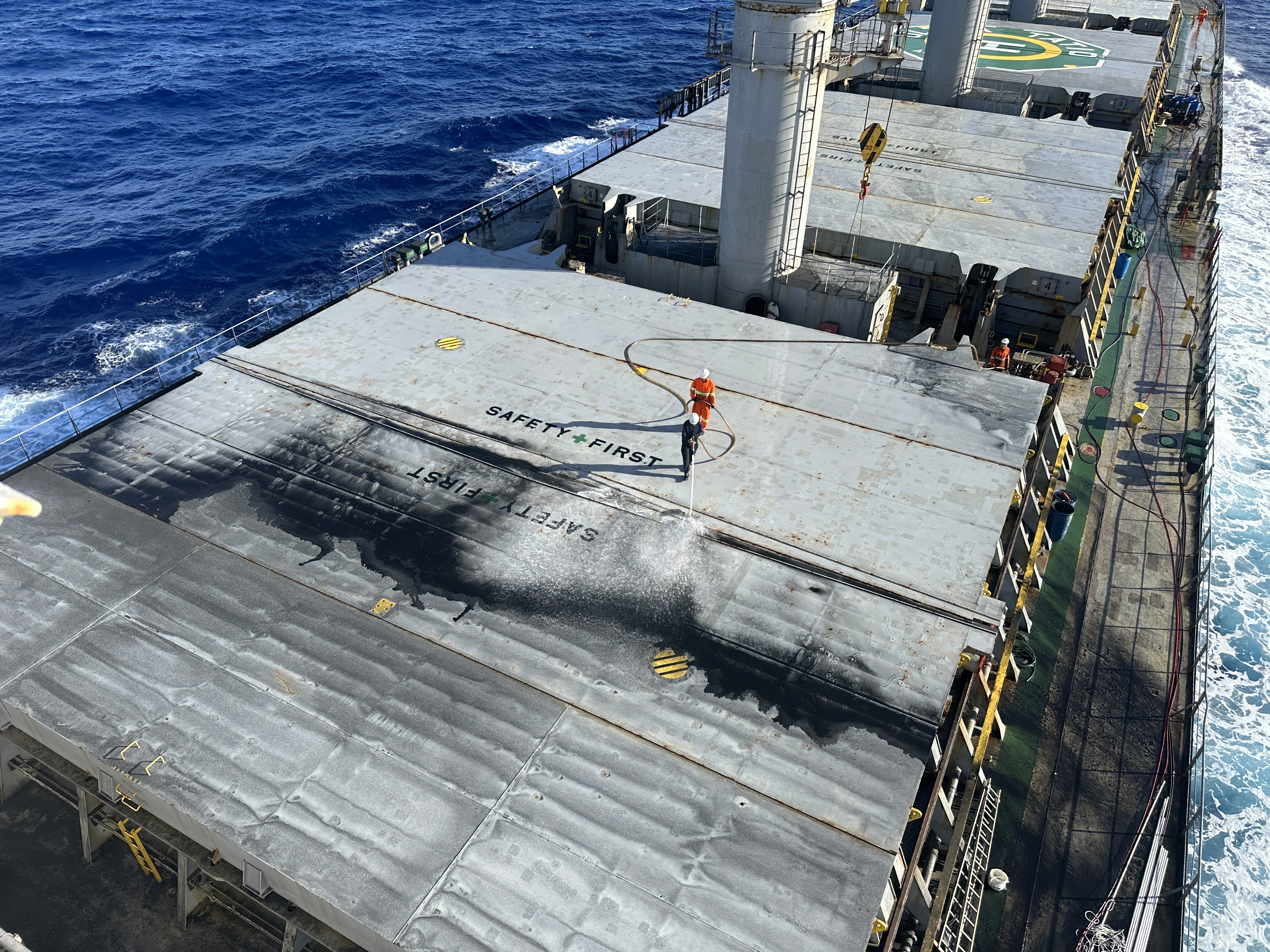
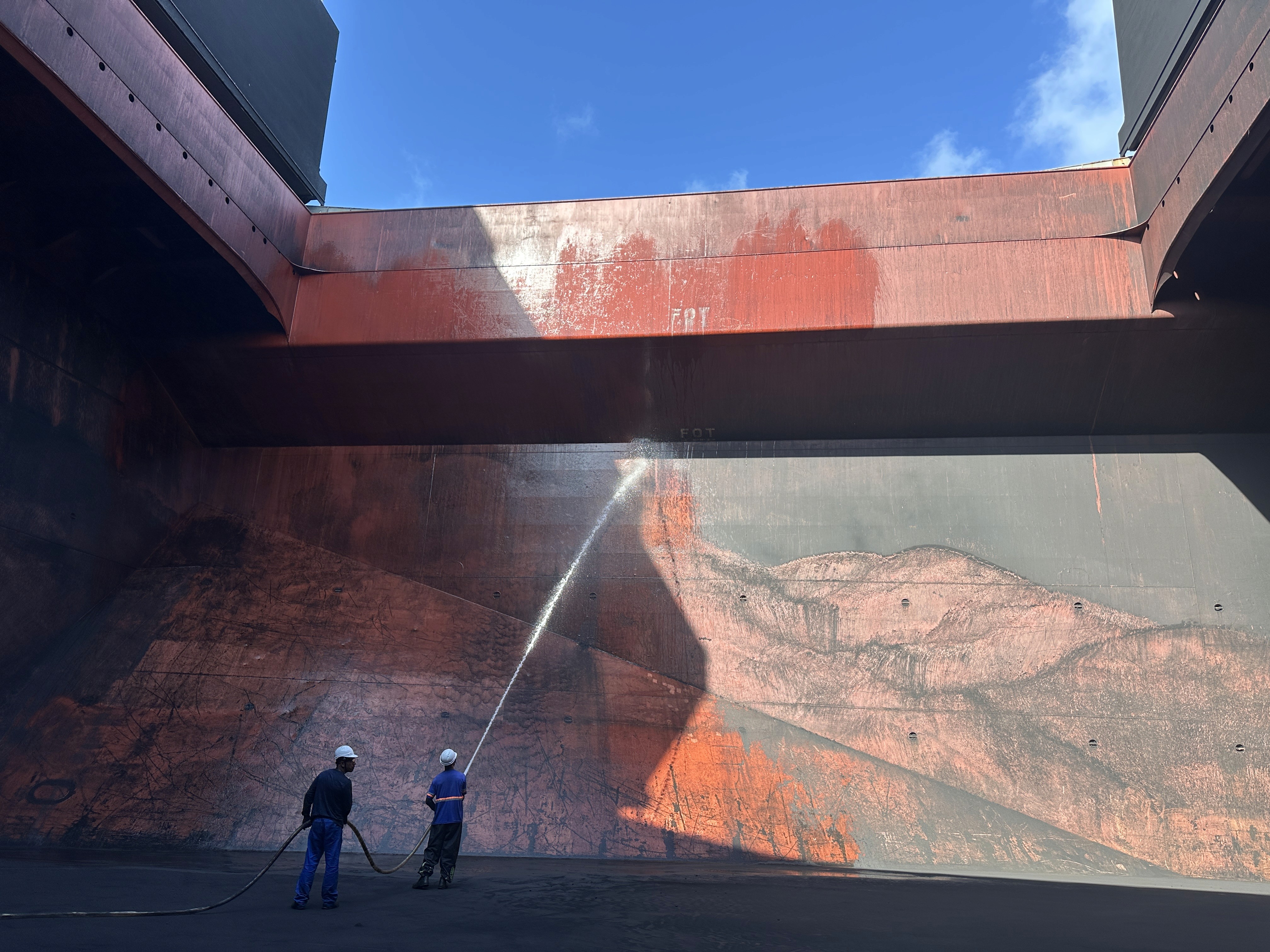
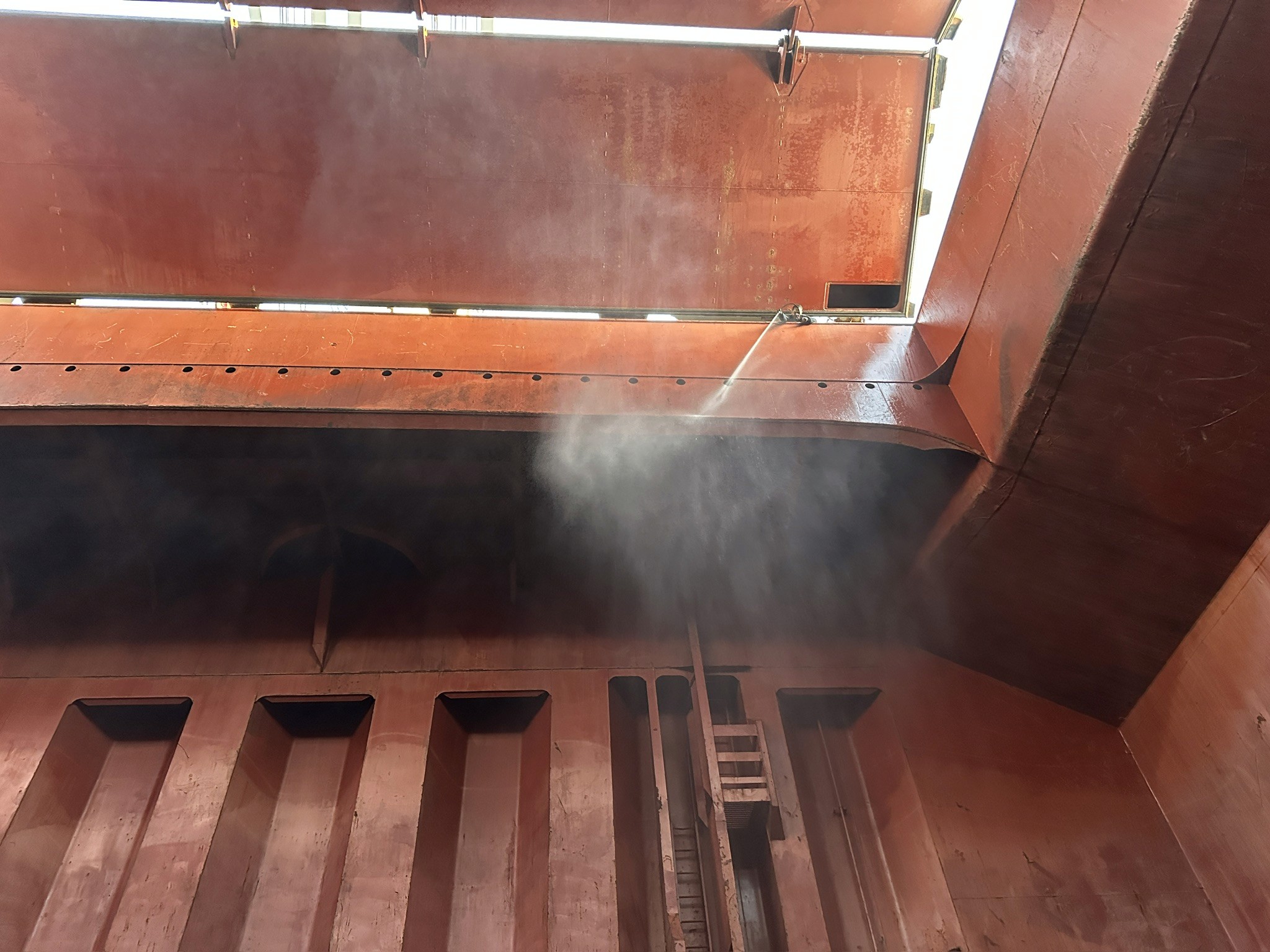
High-pressure washdown (where authorized): Using freshwater at controlled pressure (typically 150–250 bar, depending on hull condition), we wash down tanktops, frames, hatch coaming, and structural surfaces. This removes loose scale, dust, and residues.
Manual scrubbing & hand tool use: For stubborn scale, residue deposits, or in holds where high-pressure is not allowed, crew use brushes, scrapers, and hand tools to loosen and remove buildup.
Bilge well and drain cleaning: Particular attention to sump areas where heavy residues, oil, or decomposition products accumulate. These are cleaned and, where required, segregated for proper disposal.
Hatch cover & coaming inspection & cleaning: The hatch covers, rubber gaskets, and coamings are cleaned and checked for watertightness; repairs are flagged for the master's attention.
Debris collection & disposal: All loose material is collected into bags or containers and managed according to port regulations (MARPOL compliance, local authority approval, and disposal facility contracts).
4. Drying & Ventilation
Natural ventilation: With hatches open and holds exposed to air and sunlight, residual moisture evaporates. This can take 24–72 hours depending on climate and hold size.
Mechanical ventilation (if available): Some modern vessels have hold ventilation systems. These accelerate drying and are used when permitted and available.
Moisture sensitivity: For cargoes like grain, sugar, or cocoa, moisture content is critical. Drying time is verified and documented before the hold is declared ready.
5. Readiness Verification & Inspection
Visual walkthrough: The master, chief officer, or designated responsible officer conducts a final walkthrough with a checklist, documenting condition of tanktop, structural integrity, and absence of visible residues.
Independent surveyor inspection (if required): Many charters require a neutral third-party surveyor to inspect and certify the hold. We coordinate scheduling and ensure the hold is accessible for the inspector's full examination.
Analytical testing (if specified): For high-value or sensitive cargoes (premium cocoa, specialty products, some vegetable oils), samples may be taken from the hold surfaces or air to verify contamination levels meet shipper specifications.
Photographic documentation: High-resolution photos of each hold (tanktop, hatch, corners, bilge areas) are taken and included in the hold readiness file for reference and dispute avoidance.
Certification & sign-off: Once accepted, the hold is formally documented as ready. A hold readiness certificate or master's declaration is issued, signed, and filed with the bill of lading and commercial documents.
Hold Readiness Criteria: What Inspectors and Charterers Actually Look For
Hold readiness criteria are commodity-specific and vary by shipper and port authority. However, common standards include:
For Grain, Pulses, and Oilseeds
Cleanliness: Visual absence of residues from previous cargo. No visible scale, paint chips, or foreign debris.
Odor: Neutral or acceptable odor. No off-odors from prior cargoes that would impart taint to grain.
Moisture: Holds must be dry or meet moisture content specifications (typically <12% relative humidity for sensitive grains).
Structural: Tanktops and longitudinal/transverse frames must be clean and free of obvious defects.
Certification: Often verified by a grain inspector (independent surveyor) and documented on a hold readiness certificate.
For Sugar & Sweeteners
Residue-free condition: Must be free of residues from previous cargo. Risk of contamination from mineral dusts, fertilizers, or chemical residues is very high.
Moisture control: Critical. Sugar is hygroscopic and will absorb moisture if the hold is damp.
Independent inspection: Nearly always required. A certified sugar inspector will sample and test for contamination and moisture.
Analytical verification: Lab testing may include swab tests, particulate analysis, and odor assessment.
For Cocoa, Coffee, and Premium Products
Zero residue tolerance: These products are sensitive to flavor and odor taint. Holds must be inspected with extreme rigor.
Analytical certification: Swab testing and/or air sampling is standard. Particle counts and contamination levels are measured against pre-agreed thresholds.
Neutral odor: The hold must smell clean; any off-odor is grounds for rejection.
Independent inspector required: A specialist cocoa or specialty products inspector is almost always required.
For Coal, Iron Ore, and Mineral Cargo
Structural soundness: Focus is on preventing contamination of the mineral cargo with residues or debris from previous holds.
Residue-free: Holds must be swept clean of dust, cargo residue, and debris. High-pressure washdown may not be appropriate (risks damaging coatings); manual cleaning is more common.
Rust & paint condition: While minor surface rust is often acceptable, active scale or peeling paint that could contaminate the cargo is not permitted.
For Vegetable Oils
Cleanliness and residue: Zero tolerance for previous organic residues. Previous cargo history is critical (must not have been animal products, minerals, or incompatible chemicals).
Water absorption: The hold must be dry. Any residual moisture will contaminate oil quality.
Odor & aroma: Off-odors result in cargo rejection or price penalty.
Independent inspection: Standard requirement with lab certification.
No Cure, No Pay: Definition, Benefits, and Boundaries
What "No Cure, No Pay" Means
"No Cure, No Pay" is a contractual principle used in maritime services, including hold cleaning. It means:
Service is paid only upon successful completion and acceptance of the work as defined in the contract or service order.
The shipowner/operator does not pay for hold cleaning unless the holds achieve acceptance by the charterer, shipper, or independent inspector according to pre-agreed readiness criteria.
Acceptance is determined by objective, measurable standards, not subjective judgment. These are typically documented in a hold readiness certificate, inspector's report, or shipper's written acceptance.
How This Benefits Shipowners and Operators
Risk transfer: The financial risk of a failed hold inspection is borne by the cleaning service provider, not the vessel operator. This incentivizes quality execution.
Budget certainty: The operator knows the cost only if the holds actually meet acceptance standards. There is no payment for partial or remedial work unless explicitly agreed.
Accountability: The cleaning contractor is contractually obligated to deliver a hold that passes third-party inspection. This creates clear accountability for outcomes.
Dispute avoidance: When acceptance criteria are documented upfront, disagreements are minimized. Either the hold passes inspection or it does not.
What "Cure" Means in Hold Cleaning Context
"Cure" (derived from maritime salvage terminology) means achievement of readiness and acceptance. In hold cleaning, cure is confirmed by:
Visual inspection and sign-off by the master or chief officer, typically supplemented by photographic evidence.
Independent surveyor certification, if required by the charter party or shipper.
Analytical testing (lab swabs, moisture meters, odor assessment), if specified by the cargo owner.
Written acceptance from the charterer, shipper, or terminal operator.
Once one or more of these acceptance triggers is satisfied, the hold is "cured" and payment is due.
Boundaries & Exceptions: What "No Cure, No Pay" Does NOT Cover
No Cure, No Pay applies to the hold cleaning service within defined scope. However, several factors lie outside the contractor's control and are typically carved out:
Previous cargo condition: If a hold was used for incompatible cargoes repeatedly (e.g., heavy mineral dust followed by cocoa), remediation may require multiple cleans or chemical treatment beyond standard scope.
Port authority & terminal restrictions: If the port or terminal imposes cleaning restrictions (e.g., no high-pressure washdown, limited wastewater disposal capacity), the contractor can only work within those boundaries. If restrictions prevent full readiness, cure may not be achievable without relief from the port.
Vessel structural defects: If the tanktop is corroded, hatches are leaking, or the hold has structural damage that prevents proper cleaning or drying, these are owner responsibilities. The cleaning contractor cannot "cure" structural defects.
Insufficient time window: If the commercial window for cleaning is too short (e.g., 12 hours to clean and dry a large hold), readiness may not be achievable. The contract must specify realistic time allowances.
Inspection standards beyond prior agreement: If the independent inspector applies standards stricter than those originally agreed (or applies inspection criteria not communicated to the contractor beforehand), disputes can arise. Clear pre-cleaning communication with the inspector is essential.
Cargo-specific requirements not disclosed: If the shipper imposes last-minute, undisclosed requirements (specialized odor testing, specific lab protocols, etc.), these are out of scope unless separately contracted.
Best practice: The service contract should clearly define:
What "acceptance" means for this specific cargo and this specific port.
Who performs the inspection (master, independent surveyor, shipper's representative).
What inspection criteria apply (visual, analytical, photographic, etc.).
What constitutes "cure" (signed certificate, surveyor report, shipper approval, etc.).
What factors exclude the contractor from No Cure, No Pay (structural defects, port restrictions, unrealistic time windows, undisclosed requirements).
Compliance & Waste Management: MARPOL, Segregation, and Documentation
Hold cleaning generates waste: residues from the previous cargo, scale, paint flakes, water, and other materials. Handling this waste responsibly is a legal and ethical obligation under international maritime law.
MARPOL Compliance in Hold Cleaning Operations
The International Convention for the Prevention of Pollution from Ships (MARPOL) governs discharge and disposal of ship-generated waste, including residues from hold cleaning.
Key principles applicable to hold operations:
No discharge in prohibited zones: MARPOL prohibits discharge of certain wastes within 12 nautical miles of land (and stricter limits for some substances). Residues from hold cleaning must not be discharged in these zones unless authorized by a port facility.
Port facility reception facilities: Ships are required to use authorized port reception facilities for disposal of ship-generated waste, including cargo residues and hold washdown water (where capture is required).
Waste segregation & documentation: When hold washdown water or residues are collected, they must be segregated by type (organic vs. mineral, oil-contaminated vs. clean, hazardous vs. non-hazardous) and documented in the ship's Waste Record Book (if applicable) or internal logs.
Manifest & traceability: Any waste transferred ashore to a port reception facility must be tracked with a manifest or receipt confirming the facility received, documented, and will properly dispose of the waste.
Practical Hold Cleaning Waste Management
In our operations, this translates to:
Assessment of previous cargo: Before starting, we document what was in the hold. This determines how residues must be handled (some agricultural residues may be dischargeable at certain ports; others are hazardous and require special disposal).
Containment & segregation: Hold washdown water, if required to be captured (per local authority or terminal rules), is directed into labeled containers or designated holding areas. Organic residues (grain dust, sugar particles) are collected separately from scale or other mineral material.
Communication with port authorities: Before work begins, we confirm what disposal methods are permitted at the port and what reception facilities are available. Some ports have dedicated waste reception facilities; others have restrictions.
Documentation: A record is kept of what waste was generated, how it was segregated, where it was transferred, and the date and facility confirmation. This becomes part of the vessel's compliance file.
No illegal discharge: We are explicit: hold cleaning residues are not discharged overboard within territorial or coastal waters. All residues are collected, documented, and transferred to authorized shore facilities or (in cases of non-hazardous, biodegradable organic material in international waters far from land) managed in accordance with MARPOL and local authority approvals.
Transparency on Discharge & Authorization
Operational reality: in some ports or regions, wastewater handling infrastructure is limited. Local authorities may authorize limited, conditional discharge of certain non-hazardous hold washdown water at sea or in designated anchorages, provided the previous cargo history permits it and MARPOL conditions are met. These authorizations are rare and case-specific. When they apply, they are documented and communicated to the vessel before work begins.
Our principle: We operate within the law and the explicit authorization of the local port authority and terminal operator. We do not engage in surreptitious discharge or bypassing of waste management requirements. Compliance is non-negotiable.
What Changes Port-to-Port: Authorizations & Restrictions
Hold cleaning operations vary significantly from port to port, depending on infrastructure, environmental regulations, terminal policies, and local authority directives.
Ports Where We Routinely Operate
Port of Itaqui (São Luís, Maranhão, Brazil)
Infrastructure: Deep-water multi-purpose terminal with cargo hold preparation services widely used.
Authorization: Hold cleaning is permitted alongside berth and at anchorage, subject to terminal approval and vessel scheduling.
Wastewater: Terminal has reception facilities for hold washdown water. Collection and transfer is standard practice.
Inspection: Independent surveyors familiar with Brazilian cargo standards are available. Turnaround for inspection is typically 2–5 days.
Timeline: Commercial window is usually 1–3 days; adequate for routine hold cleaning and drying.
Port of Recife (Pernambuco, Brazil)
Infrastructure: General cargo port with some hold cleaning capability, though less specialized than Itaqui.
Authorization: Hold cleaning is permitted, but coordination with port authority and terminal operator is required. Some terminals have stronger restrictions on wastewater discharge.
Wastewater: Varies by terminal. Some facilities have containment; others require the vessel to contract external disposal.
Inspection: Surveyors available; turnaround may be 3–7 days depending on surveyor availability.
Timeline: Often more time-constrained than Itaqui. Planning is critical.
Port of Cabedelo (Paraíba, Brazil)
Infrastructure: Dry bulk terminal with agricultural commodity expertise.
Authorization: Hold cleaning is integral to cargo operations. Methods and wastewater handling are well-established.
Wastewater: Terminal facilities are available; waste segregation and disposal are routine.
Inspection: Grain and commodity inspectors are readily available.
Timeline: Typically 1–3 days; suitable for routine hold preparation.
More Restrictive Ports
Other Brazilian ports—and international ports in regions with stricter environmental regulations—may impose tighter controls:
No high-pressure washdown: Some ports prohibit high-pressure spraying due to wastewater management limitations or environmental sensitivity. Manual cleaning and light freshwater wash are substituted.
Containment mandatory: All hold washdown must be captured and transferred ashore; no overboard discharge of any kind (even washdown water from non-hazardous cargoes).
Limited commercial windows: Smaller ports or those with congestion may offer only 24–48 hours for hold preparation, requiring efficient execution or rework.
Independent inspection required at all ports: Some jurisdictions (particularly those handling high-value or regulated commodities) require a neutral surveyor on every hold, increasing cost and schedule.
Anchorage vs. Alongside Operations
The location of cleaning—at anchor vs. alongside a berth—depends on operational and regulatory factors:
Alongside (Berth):
Advantages: Terminal access to wastewater reception facilities; crew safety improved by being tied fast; easier supervision and equipment support.
Disadvantages: Terminal operational windows may be limited; berthing fees are incurred; coordination with cargo operations is complex.
When used: When the port has dedicated berth space and terminal infrastructure, and the commercial schedule permits.
At Anchorage:
Advantages: May be faster to position; avoids terminal congestion; lower berth fees.
Disadvantages: More challenging wastewater management (may require collection and transfer by boat); weather dependency; crew safety protocols must be stricter; inspection logistics are more complex.
When used: When the port is congested, berthing is not immediately available, or the vessel has been approved for anchorage operations.
Decision criteria: The decision is made by the vessel's master, in coordination with the shipowner, charterer, and port authority. Safety, compliance, logistics, and cost efficiency are weighed.
Safety Culture: Permits, Monitoring, and Operational Discipline
Hold cleaning is hazardous work. It involves confined space entry, high-pressure equipment, chemical residues, and extended exposure to below-deck environments. Professional execution requires rigorous safety protocols.
Confined Space Entry & Atmospheric Monitoring
Entry authorization: Before any person enters a hold, the master or chief officer issues a formal "Permit to Work" or confined space entry permit, documenting that atmospheric testing has been completed and hazards identified.
Gas testing: Using calibrated gas detection equipment, we test for oxygen levels (must be 19.5–23.5%), carbon dioxide, hydrogen sulfide, and combustible gases. All readings are documented; the hold is not entered if gases are out of range.
Continuous monitoring: During the cleaning operation, if workers remain below deck for extended periods, atmospheric monitoring is repeated at least hourly. If readings deteriorate, work stops and ventilation is increased until safety is restored.
Ventilation: Hatches remain open; mechanical ventilation is used where available; fans are positioned to push fresh air into the hold and pull stale air out.
PPE & Protective Equipment
Respiratory protection: If atmospheric conditions are marginal, breathing apparatus or supplied-air respirators are used.
Safety harness & lifeline: Workers in confined spaces wear safety harnesses tethered to a manned deck line. A trained rescue watchman is assigned; no one works alone below deck.
Hard hats, safety shoes, gloves: Standard on all deck work.
Eye & skin protection: Depending on residues and cleaning agents, safety glasses and protective clothing are worn.
Toolbox Talks & Crew Briefing
Before work begins, all personnel involved—deck crew, cleaning service technicians, visiting inspectors—participate in a pre-job briefing covering:
Hazards specific to this hold (what was the previous cargo; are there known residues or odors).
Work method and sequence.
Confined space entry rules and atmospheric testing.
Emergency procedures and rescue contacts.
Equipment operation and safety guards.
Spill response and cleanup.
Supervisor contact and communication method.
Supervision & Documentation
A designated supervisor (usually a senior deck officer or hold cleaning operations manager) is present during all work, monitoring progress, enforcing safety rules, and documenting any incidents or near-misses. A log is kept recording the date, start/end times, personnel involved, work completed, any issues, and sign-off.
Incidents & Near-Miss Reporting
Any unsafe condition, incident, or near-miss is reported immediately to the master and documented. If a worker is overcome, overcomes atmospheric hazard, or sustains injury, work is halted; emergency protocols are activated; and a formal investigation follows.
Step-by-Step: A Practical Hold Cleaning Checklist for Clients
Use this checklist to understand the flow of a professional hold cleaning operation and track its progress.
Before Cleaning Starts
Confirm the incoming cargo type and shipper/charterer acceptance criteria.
Request the previous hold history: what was loaded, how long it was aboard, when it was discharged.
Clarify the available commercial window (hours/days available for cleaning, drying, and inspection).
Identify the port authority and terminal contact; confirm what cleaning methods are permitted.
Confirm wastewater disposal: is it available at the port? What is the cost and timeline?
Schedule the independent surveyor (if required) well in advance; provide the expected readiness date.
Ensure the vessel has current calibrated atmospheric testing equipment and trained personnel.
Review the previous hold cleaning records aboard; confirm crew competency and PPE availability.
During Cleaning
A pre-job safety briefing is conducted with all personnel; a Permit to Work is issued.
Atmospheric testing is completed and documented before entry.
Work proceeds methodically: high-pressure wash (if authorized), manual cleaning, residue collection, bilge management, ventilation.
A supervisor is continuously present; work is logged.
All waste is contained and segregated as required; disposal arrangements are confirmed.
Drying is allowed adequate time (24–72 hours, depending on hold size, climate, and cargo sensitivity).
Progress photos are taken at key milestones (start, mid-clean, post-wash, post-dry).
Before Sign-Off
The master or chief officer conducts a final visual walkthrough with a photographic checklist.
Independent surveyor inspection is coordinated; the surveyor conducts a full walkthrough and issues a report or certificate.
Any analytical testing (lab swabs, moisture meters) is completed and results are reviewed.
Discrepancies or areas flagged by the surveyor are remediated and re-inspected if necessary.
Once accepted, a hold readiness certificate or master's declaration is signed and filed.
All documentation (inspection report, photographic evidence, waste disposal receipts, permits) is compiled and attached to the vessel's file and bill of lading.
Frequently Asked Questions: Hold Cleaning & Hold Readiness
Q1: What is the difference between "hold readiness" and "hold discharge"?
A: Hold discharge refers to the pumping or conveying of cargo out of a hold. Hold readiness is the condition and certification of the empty hold before the next cargo is loaded. Readiness is about cleanliness, structural integrity, and suitability for the next cargo. Discharge is about the operational logistics of moving cargo.
Q2: Why do some holds fail inspection if they look visually clean?
A: Visual cleanliness is necessary but not sufficient. Inspectors look for:
Residual odors from previous cargo (invisible to the eye but detectable by smell or lab testing).
Particulate contamination (scale, paint chips, dust) that may not be obvious but is present in corners, bilge wells, or frame gaps.
Moisture content (for hygroscopic cargoes like grain or sugar).
Chemical residue incompatibility with the incoming cargo.
Independent surveyors use swab tests, odor assessment, moisture meters, and visual inspection under bright lighting to detect what a casual eye misses.
Q3: How long does hold cleaning typically take?
A: It depends on hold size, previous cargo condition, and cleaning method. A small hold (500 m³) with light residues may be cleaned in 12–24 hours. A large hold (4,000+ m³) with heavy scale or stubborn residues may require 48–72 hours. Drying adds an additional 24–72 hours. Total time is typically 3–5 days for routine operations; sometimes longer if issues are discovered during cleaning.
Q4: What if the hold fails inspection after cleaning?
A: The contractor is obligated (under No Cure, No Pay) to remediate at no additional cost. This might involve:
Re-washing specific areas flagged by the inspector.
Extended drying (if moisture is the issue).
Manual removal of scale or residue not fully removed in the first clean.
Second-pass inspection.
If the defect is found to be caused by a vessel structural issue (e.g., a leaking hatch causing moisture, or active corrosion) or a port restriction preventing certain cleaning methods, disputes can arise. Clear pre-contract communication prevents most conflicts.
Q5: Are there chemicals or additives used in hold cleaning? Are they safe?
A: Freshwater washdown is the standard method and requires no chemical additives. In some cases (e.g., heavy oil or grease residue), a mild biodegradable detergent or caustic solution may be used. Any chemical is:
Specifically approved for use aboard ship.
Applied in controlled concentration.
Thoroughly rinsed away with freshwater.
Documented in the work log.
Crew are briefed on safe handling, PPE, and disposal. Chemical residues are not left aboard; they are flushed away or collected and properly disposed of ashore.
Q6: Do inspectors test for allergens or food safety contaminants?
A: For specialty commodity cargoes (cocoa, nuts, grains destined for human food), inspectors may conduct lab testing for allergen residue, mycotoxins, or pathogenic contamination. These tests are specified by the shipper and are case-specific. They are not routine for all cargoes but are becoming more common for premium or food-safety-sensitive products.
Q7: Can hold cleaning be done while cargo is being loaded or discharged?
A: No. Hold cleaning is performed on empty holds only. Cargo must be fully discharged, the hold must be cleared of any residue, swept, and washed before the next cargo loading. Attempting to clean with cargo aboard creates safety hazards, contamination risk, and operational chaos.
Q8: What is the cost of hold cleaning, and how is it determined?
A: Cost varies by:
Hold size and volume.
Condition (previous cargo, degree of fouling, scale thickness).
Cleaning method required (high-pressure vs. manual).
Port wastewater disposal fees.
Independent inspection (if required).
Time window available.
Specific cargo requirements.
A small, routine hold cleaning at Itaqui might range from USD 18,000–25,000. A large hold with heavy residues and analytical certification could range from USD 20,000–27,000+. We provide detailed quotations based on vessel specifics and cargo requirements.
Q9: Is hold cleaning included in ship maintenance or is it an operational service fee?
A: Hold cleaning is an operational service, not routine maintenance. It is charged to the voyage or charter and is typically borne by the charterer (the party benefiting from having clean holds for cargo). The cost is part of port costs and can be negotiated into charter party terms or passed through as an operating expense.
Real-World Scenario: The Grain Trader's Perspective
To illustrate why hold readiness matters, consider a typical scenario:
A large bulk carrier discharges iron ore and is scheduled to load soybeans (a high-value commodity) in three days. The grain trader (shipper) has strict contamination limits: no residue from ferrous material (iron dust) or mineral scale, no moisture above 12%, and independent grain inspector certification required.
If the holds are cleaned superficially—visually swept but not washed, not fully dried, and no inspector verification—the grain trader's inspector will likely reject the loads. This results in:
Delayed loading; the vessel misses its narrow cargo availability window.
Demurrage accruing at USD 80/day for 2–5 additional days while rework happens.
Shipper loss of sale opportunity if cargo must be redirected to another vessel.
Reputational damage: this vessel is now flagged in the shipper's system as unreliable.
Conversely, if holds are professionally cleaned—washed, dried, and independently verified with a signed grain readiness certificate—the shipper loads with confidence. The cargo quality is protected; the vessel stays on schedule; the shipowner's reputation is reinforced.
That is the operational and commercial reality of hold readiness.
Safety, Efficiency, and Continuous Improvement
At Seachios®, hold cleaning is not treated as a commodity service. It is a technical operation requiring skilled execution, safety discipline, and attention to detail.
Our approach includes:
Root cause analysis: After every job, we review what went well and what could be improved. Did a hold require rework? Why? Was it a procedural issue, a training gap, or an unexpected vessel condition?
Crew competency: All personnel involved in hold cleaning receive formal training in confined space entry, atmospheric testing, high-pressure equipment operation, and safety protocols. Training is renewed regularly.
Equipment maintenance: High-pressure washers, gas detection equipment, lighting, and collection containers are maintained and calibrated to ensure safe, reliable operation.
Documentation & traceability: Every job is documented with photos, inspection reports, atmospheric test records, and waste disposal receipts. This creates a body of evidence that protects all parties and supports continuous improvement.
Conclusion: Your Next Steps
Hold readiness is not a minor detail in shipping operations—it is the foundation of cargo care, schedule adherence, and commercial credibility. Professional execution protects cargo quality, meets shipper expectations, reduces demurrage risk, and strengthens the vessel's reputation in the market.
If your vessel requires cargo hold cleaning and hold readiness certification, Seachios® Marine Services is ready to support you with:
Operational expertise built on 45+ years of experience and 180,000+ holds cleaned.
Clear No Cure, No Pay terms that align our incentives with yours.
Safety-first execution and full compliance with international and local regulations.
Transparent documentation and independent verification.
For a technical assessment of your vessel's hold condition and a detailed quotation tailored to your cargo and schedule, contact Seachios® at your earliest convenience. We will review your specific requirements and provide a professional proposal within 24 hours.
Your cargo deserves a hold that is not just empty—it is certified as ready.
This article was prepared by Seachios® Marine Services, a maritime operational services company specializing in cargo hold cleaning, tank cleaning, underwater inspections & cleaning, and marine agency services across Brazilian ports since 1980. The company brings decades of hands-on experience in hold preparation and vessel operations. All information is subject to local authority approvals, port-specific regulations, and case-by-case operational conditions.
KEYWORDS: Cargo hold cleaning, Hold washing, Hold preparation, Hold readiness, No cure no pay, Cargo hold inspection, Ship hold cleaning service, Hold discharge procedure, Pre-loading hold condition
About author
The Seachios® Media & Press Team ensures consistent and authoritative communication across the maritime and industrial sectors. Managing press relations, official statements, and technical publications, the team strengthens the company’s reputation and reinforces its commitment to clients and partners worldwide.

Seachios® Media & Press Team
Corporate Communications
Subscribe to our newsletter
Sign up to get the most recent blog articles in your email every week.